
The year 2026 marks a definitive inflection point for the United Kingdom’s public sector. We have moved beyond the era of aspirational digital transformation and entered a period of operational consolidation and rigorous accountability.
With the enforcement of the GovAssure compliance regime and the publication of the Government Cyber Action Plan, the days of “self-assessment” are over. Government bodies are no longer merely encouraged to be secure; they are mandated to demonstrate resilience against an evolved and constantly evolving threat landscape.
For CISOs, CDIOs, and Senior Responsible Owners (SROs), navigating this landscape requires a focus on interconnected strategic priorities.
The Era of Assured Compliance (GovAssure)
The transition to GovAssure signals the end of “watermelon reporting” where projects appeared green to the outside world but remained red (vulnerable) on the inside. Built on the NCSC’s Cyber Assessment Framework (CAF) v4.0, this regime requires evidence-based validation of security outcomes.
-
- The Deadline: By 31st March 2026, all organisations must submit assessments via WebCAF.
-
- Independent Audit: From the 2026-27 cycle, third-party audits under the Cyber Resilience Audit (CRA) scheme will become the standard.
-
- Operational Focus: Auditors now require logs, penetration test results, and proof of immutable backups rather than just policy documents.
Navigating GovAssure is resource intensive. Mobilise Cloud provides Security Support Services that help overcome these resource short falls, including cloud “Dry Run” audits and evidence curation, vulnerability reviews, to bridge the gap between technical reality and compliance requirements.
Legacy Modernisation as a Security Mandate
Legacy IT is no longer just a financial burden; it is an existential security risk. In 2026, legacy systems consume up to 50% of some departmental budgets, yet they often cannot support modern essentials like Multi-Factor Authentication (MFA) or micro-segmentation.
To meet the Secure by Design mandate, departments must move away from “Lift and Shift” migrations. Instead, the focus has shifted to:
-
- The “Strangler Fig” Pattern: Gradually replacing legacy monoliths with secure microservices.
-
- Serverless & Containerisation: Utilising architectures like AWS Lambda or EKS to outsource underlying OS patching to the cloud provider.
-
- Compliance-as-Code: Using automated guardrails to prevent insecure configurations from reaching production.
Fortifying the Supply Chain
A government body is only as secure as its weakest supplier. Recent data indicates that only 14% of organisations have effective visibility into the risks posed by their immediate supply chain.
The April 2026 Cyber Essentials “Reset” introduces stricter requirements:
-
- Mandatory MFA for all cloud services used by suppliers.
-
- Zero tolerance for unsupported or end-of-life software.
-
- Sovereign Support: A growing requirement for UK-based, SC-cleared support teams to ensure data remains within UK jurisdiction.
At Mobilise Cloud, our status as an AWS Managed Service Provider with ISO27001 accreditation and SC-cleared staff allows us to act as a “Trusted Partner,” sharing the risk rather than just selling a product.
Governing the AI Frontier
2026 has seen the rise of Agentic AI autonomous agents capable of conducting multi-stage cyber-attacks at machine speed. This has transformed the threat landscape from human-led phishing to automated, high-fidelity social engineering.
To counter this, public sector bodies are adopting Sovereign AI Governance:
-
- Private AI Models: Deploying LLMs within secure, departmental cloud environments (e.g., AWS Bedrock) to prevent sensitive data from leaking into public training sets.
-
- AI-Augmented SOCs: Using AI to triage the vast volume of telemetry and identify “low and slow” attack patterns that human analysts might miss.
-
- Red Teaming: Actively testing AI models for “Prompt Injection” vulnerabilities.
Zero Trust Architecture & Identity
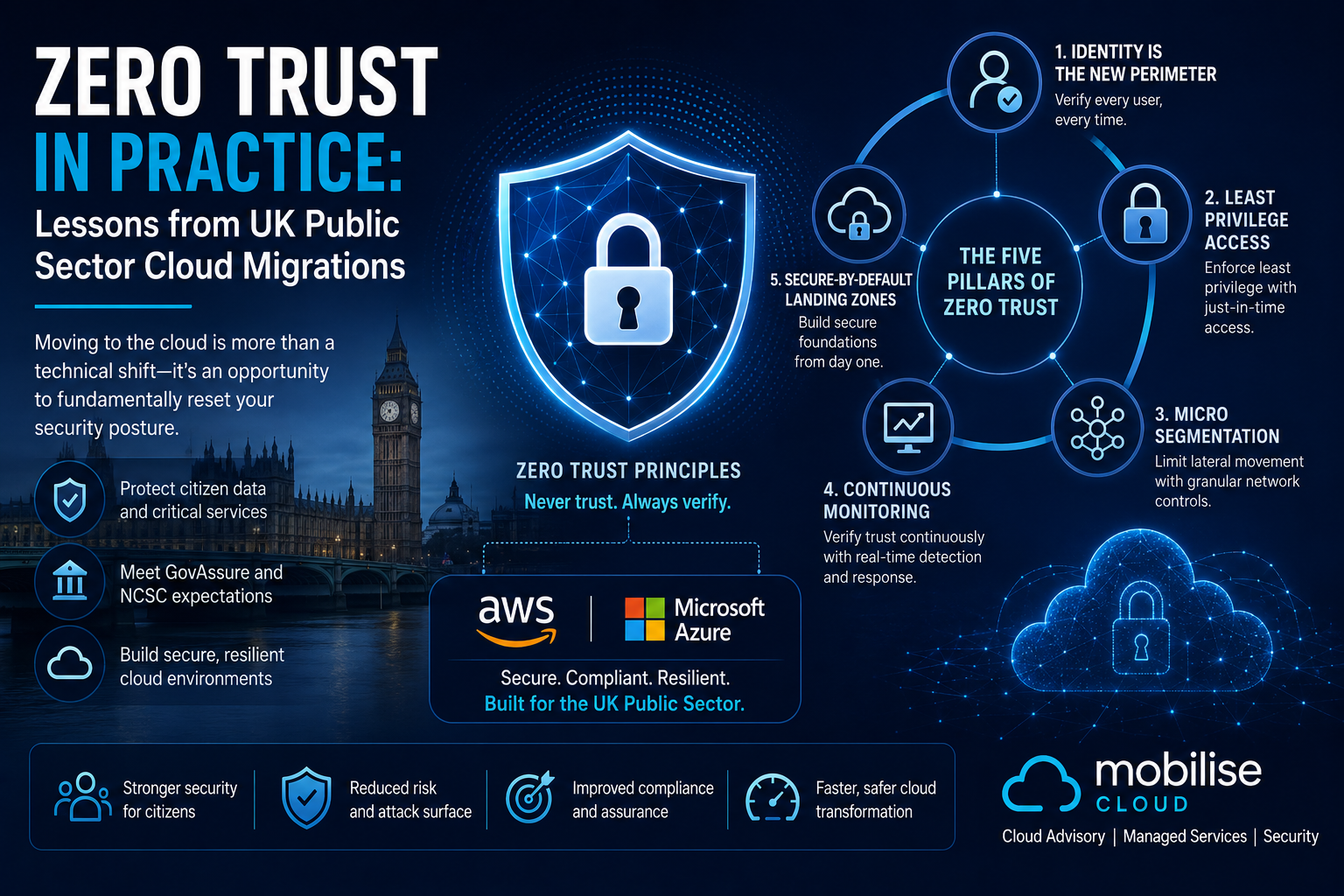
The network perimeter has dissolved. The Public Services Network (PSN) is being phased out in favour of internet-native access models underpinned by Zero Trust Architecture (ZTA).
Key pillars for 2026 include:
-
- Identity as the Control Plane: Moving beyond one-time logins to Continuous Verification based on user behaviour and device health.
-
- Phishing-Resistant MFA: Shifting toward hardware-based keys (FIDO2) to combat AI-driven social engineering.
-
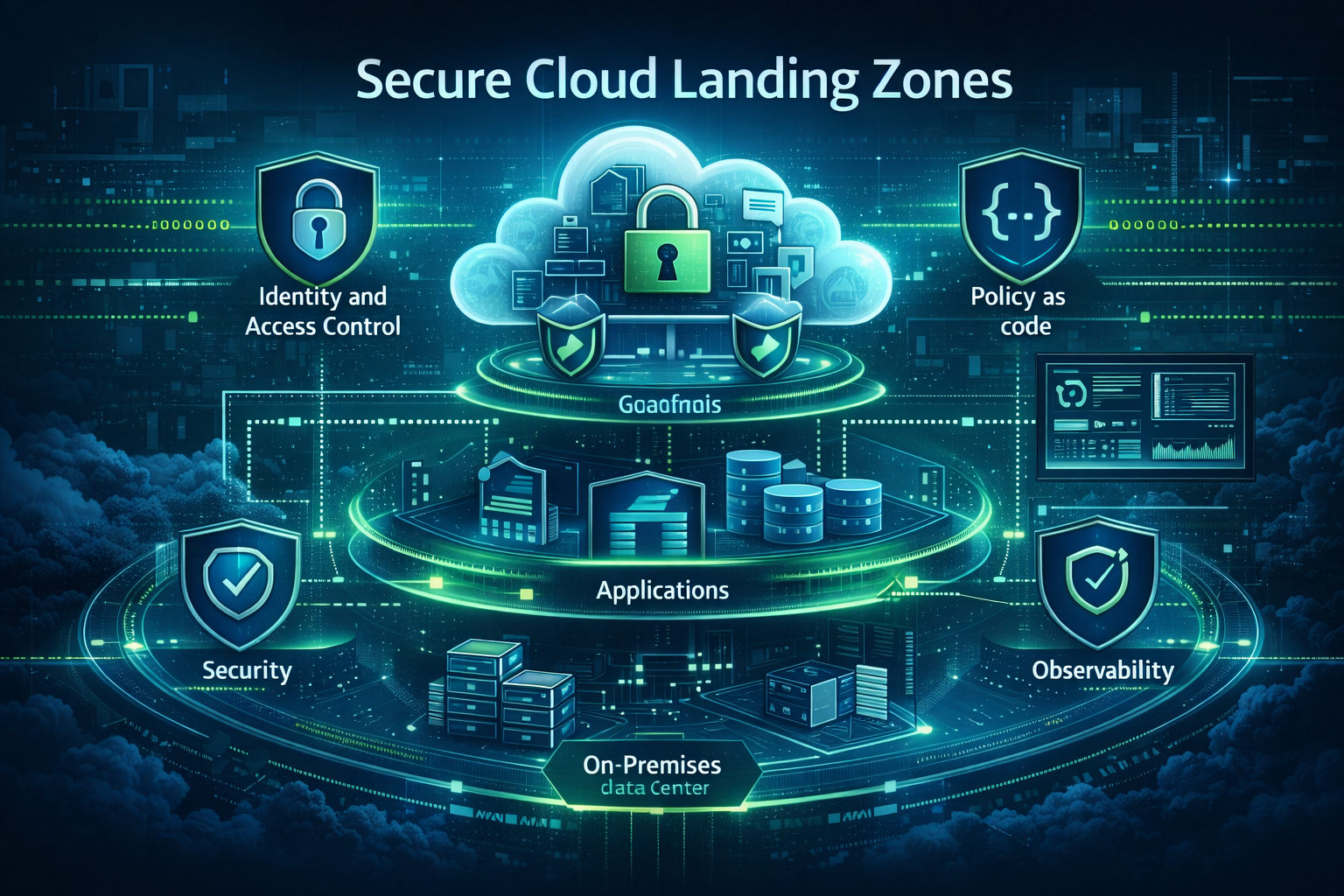
- Landing Zones: Implementing pre-configured environments and landing zones, such as the Police Assured Landing Zones (PALZ), which enforce Zero Trust principles by default.
Looking Towards 2030
The convergence of GovAssure, Secure by Design, and AI threats creates a perfect storm for security leaders. However, it also provides the necessary business case to modernise.
The foundation for that future is being built today. By focusing on these five priorities, UK public sector bodies can ensure they remain resilient, compliant, and ready for the challenges of the late 2020s.