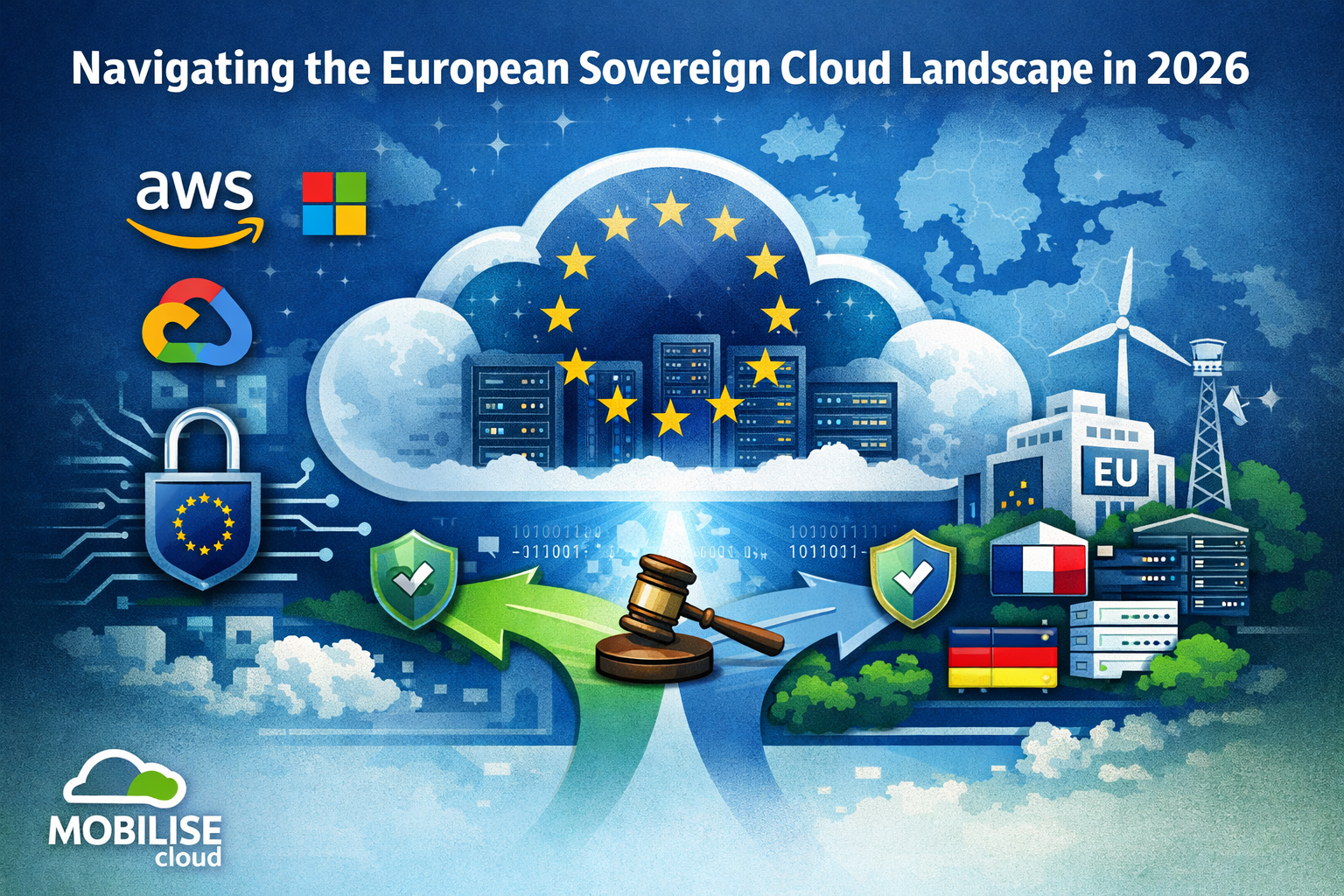
In 2026, “the cloud” is no longer just about where your data sits; it is about who has the keys to the room and which laws apply when someone knocks on the door. For European organisations, Digital Sovereignty has moved from a compliance “checkbox” to a core strategic pillar.
At Mobilise Cloud, we are seeing a significant talk around this very topic and shifts in the EU market. While the “Big Three” hyperscalers continue to dominate, a new breed of European-native providers is offering a genuine alternative for those who need absolute legal and operational independence.
Here is our high-level guide to the sovereign cloud landscape in Europe today.
The Hyperscaler “Sovereign” Offerings
AWS, Microsoft Azure, and Google Cloud have all launched dedicated European sovereign solutions to counteract the reach of the US CLOUD Act.
AWS European Sovereign Cloud: A physically and logically separate partition of AWS, operated and supported entirely by EU-resident AWS employees.
Advantage: Access to the full-throttle AWS ecosystem (AI, Lambda, Bedrock) while keeping data strictly within the EU.
Disadvantage: Despite the “moat,” the underlying technology remains American, which still raises “technical sovereignty” questions for the most sensitive government sectors.
Microsoft Cloud for Sovereignty / “Bleu”: Often delivered via partnerships (like Bleu in France), Microsoft offers sovereign controls on top of Azure.
Advantage: Unbeatable integration with the Microsoft 365 stack and existing enterprise agreements.
Disadvantage: Complex “partnership” models can lead to fragmented support experiences compared to a native provider.
Google Sovereign Cloud (via T-Systems/S3NS): Google uses a “partner-led” model where European entities like T-Systems (Germany) or S3NS (France) manage the encryption keys and operations. Advantage: Leading-edge AI and data analytics tools (Vertex AI) delivered through a local, trusted interface.
Disadvantage: You are essentially paying a “sovereignty tax”—higher costs for the same services due to the additional partner layer.
The European Cloud Powerhouses: Native Sovereignty
If your priority is immunity from non-EU jurisdictions and a commitment to open standards, these are the providers to watch. Our tech team did some research gave the ones we can access a whirl to find out how they tick, here’s our thoughts:
| Provider | Advantages | Disadvantages |
| OVHCloud | Openness & Cost, built on open-source standards with no egress fees. Excellent for avoiding vendor lock-in. | Service Depth, while their IaaS is robust and covers the base needs nicely, they lack the vast library of higher-level PaaS tools found on AWS or Azure. |
| Hetzner Cloud | Performance-to-Price, incredibly lean and fast. Known for providing the best “bang for your buck” in raw compute power. | Developer Support, Minimal “hand-holding.” It is built for experienced DevOps teams; beginners may find the lack of managed services daunting. |
| T-Cloud (Telekom) | Compliance Heavyweight, backed by Deutsche Telekom, offers unparalleled “German-grade” security and industry-specific certifications (C5, TISAX) as well as a wide range of IaaS, PaaS and SaaS. | Agility, The enterprise-heavy focus can sometimes result in slower deployment cycles compared to “cloud-native” startups. Noticeable in how unfriendly their UI is to navigate. |
| STACKIT (Schwarz) | Retail-Hardened, The cloud arm of the Schwarz Group (Lidl/Kaufland). It is a “cloud for the real economy,” designed for massive scale and resilience. | Ecosystem Maturity, still growing its partner marketplace. You might find fewer third-party integrations compared to more established players. Also only allows EU based entities to use it, so currently a no-UK allowed club. |
It should be noted that all of these cloud providers each have their own Terraform providers in different states of maturity, so if like us at Mobilise you are a IaC first then UI, navigation problems become less of an issue.
Which Route Should You Take?
Choosing a cloud provider in 2026 is a balancing act between innovation and protection.
- If you need Cutting-edge AI and global scale, the Hyperscaler Sovereign editions are likely your best bet.
- If you are a Public Sector body or an Operator of Essential Services and have legal concerns then potentially a native provider like T-Cloud or OVHcloud offers a much “cleaner” legal profile.
At Mobilise Cloud, we can help you navigate these trade-offs to build a multi-cloud strategy that doesn’t sacrifice performance for peace of mind.