DevSecOps in 2026: Why Embedding Security Into Your Pipeline Is No Longer Optional
The End of Bolted-On Security
For years, security was the stage gate at the end of a delivery pipeline, a manual review, a penetration test, a sign-off meeting that happened weeks after code was written. Developers built. Security teams reviewed. And the inevitable friction between speed and safety slowed everyone down.
In 2026, that model is no longer viable. The pace of cloud-native development, the scale of modern deployment pipelines, AI-driven development, and the sophistication of the threat landscape have made one thing clear: if security isn’t embedded into the pipeline itself you are missing key early-stage detection and remediations.
DevSecOps, the practice of integrating security into every phase of the software development lifecycle has moved from progressive practice to industry expectation. Organisations that haven’t made this shift aren’t just accepting more risk. They’re falling behind operationally, losing ground on compliance, and making their infrastructure and applications a softer target.
At Mobilise, DevSecOps isn’t a separate service we bolt onto delivery. It’s how we build. This blog explores what a mature, security-embedded pipeline looks like in 2026, the common gaps we see in client environments, and the practical steps to close them.
Why 2026 Is the Tipping Point
Several converging forces have made DevSecOps a necessity rather than an aspiration.
Cloud-native architectures multiply the attack surface. Microservices, containers, serverless functions, and API gateways mean there are far more components to secure — and each one is deployed independently, often multiple times a day. Manual security reviews simply can’t keep pace.
Compliance frameworks now expect automation. Whether you’re working within GovAssure, ISO 27001, SOC 2, or sector-specific regulations, auditors increasingly expect to see evidence of automated security controls. A manual pentest every quarter or year isn’t sufficient when you’re deploying dozens of changes a week.
AI-powered threats are faster than human defenders. Adversaries are using AI to scan for misconfigurations, craft targeted phishing payloads, and exploit newly disclosed vulnerabilities within hours of publication. Your defences need to operate at the same speed which means they need to be automated.
The skills gap is real. There aren’t enough specialist security engineers to embed one in every delivery team. DevSecOps addresses this by codifying security expertise into tooling, guardrails, and automated policies that every developer benefits from, without needing to be a security expert themselves.
What a Mature DevSecOps Pipeline Looks Like
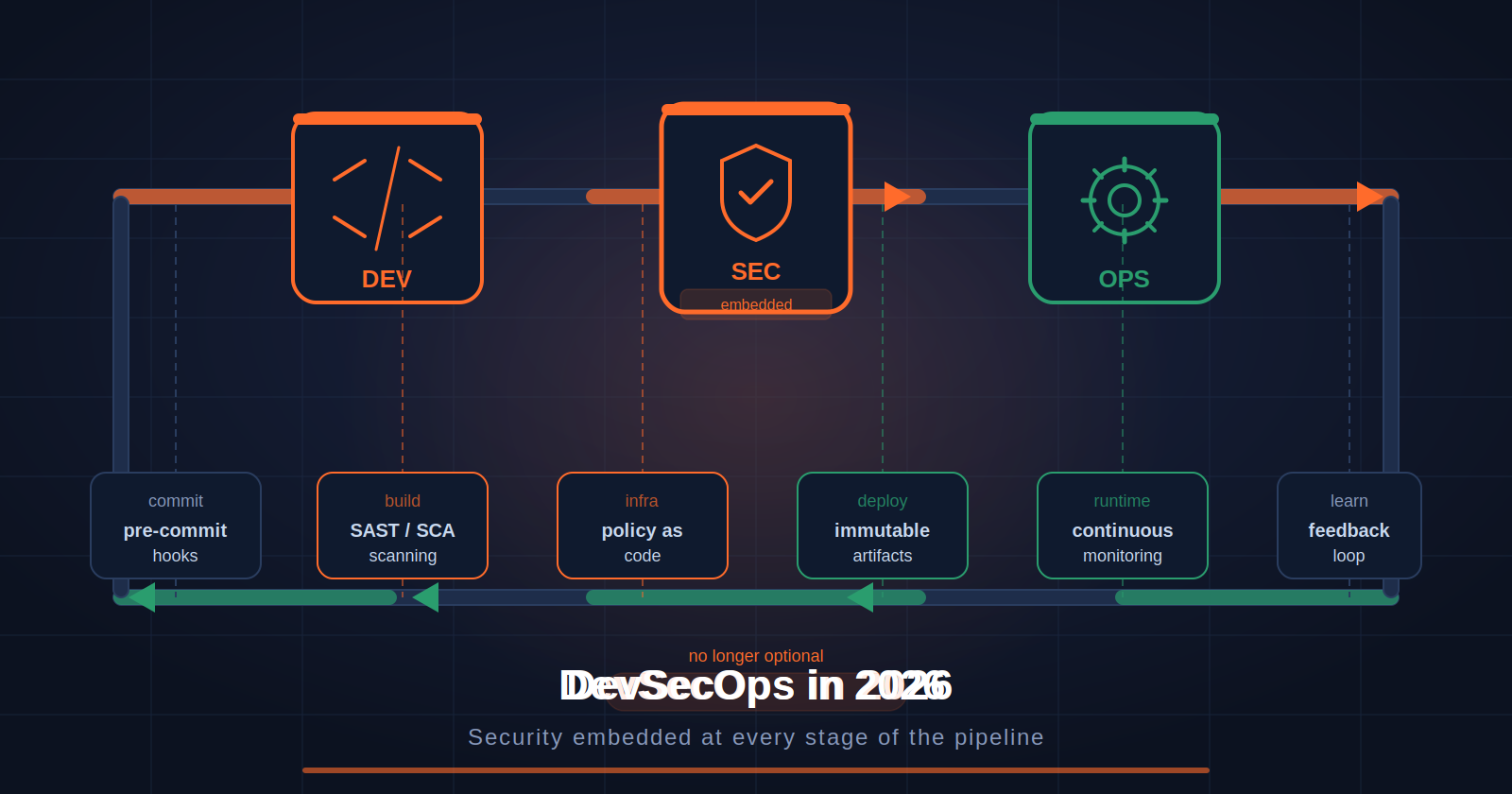
A truly integrated DevSecOps pipeline doesn’t just add a scanning tool to your CI/CD workflow and call it done. It embeds security thinking and automated controls at every stage from code commit to production monitoring.
Code: Secure by Design
Security starts before a single line of code is written. Threat modelling during design, secure coding standards, and pre-commit hooks that catch secrets, credentials, and known vulnerable patterns before they enter version control.
Practically, this means running tools like git-secrets or TruffleHog as pre-commit hooks to prevent API keys and passwords from being committed. It means maintaining a set of approved libraries and base images that have been vetted for known vulnerabilities. And it means making secure coding guidance accessible and practical, not a 200-page policy document nobody reads.
Build: Automated Scanning at Every Commit
When code is committed and the build pipeline triggers, automated security scanning should happen as a native step not an afterthought. This includes:
Static Application Security Testing (SAST) to analyse source code for vulnerabilities without executing it. Tools like SonarQube, Semgrep, or Checkmarx integrate directly into CI pipelines and provide feedback to developers within minutes.
Software Composition Analysis (SCA) to identify known vulnerabilities in third-party libraries and dependencies. With modern applications relying heavily on open-source packages, SCA is essential. Tools like Snyk, Dependabot, or OWASP Dependency-Check flag vulnerable dependencies and can block builds automatically.
Container image scanning for Docker images and OCI containers. Before any image is pushed to a registry, it should be scanned for OS-level vulnerabilities, misconfigured base layers, and embedded secrets. AWS ECR image scanning, Azure Defender for Containers, and tools like Trivy handle this natively.
The critical principle: scanning should fail the build when critical or high-severity issues are found. If security scans are advisory-only and developers can ignore the results, you have a reporting tool, not a security control.
Infrastructure: Policy as Code
In cloud-native environments, infrastructure is defined in code Terraform, CloudFormation, Bicep, Pulumi, you name it. This creates an opportunity to enforce security policies before infrastructure is ever provisioned.
Policy-as-code tools like Open Policy Agent (OPA), HashiCorp Sentinel, or AWS CloudFormation Guard evaluate infrastructure definitions against security rules and block non-compliant deployments. Examples include: no public S3 buckets, all RDS instances must have encryption at rest enabled, no security groups allowing 0.0.0.0/0 ingress on port 22.
At Mobilise, we treat policy-as-code as the single most impactful DevSecOps practice for cloud environments. It catches misconfigurations, the leading cause of cloud security incidents, before they reach production, and it scales effortlessly across accounts and subscriptions.
Deploy: Immutable and Auditable
Deployments should be immutable meaning that production artifacts are built once, scanned, signed, and promoted through environments without modification. This ensures that what was tested is what runs in production, and provides a clear audit trail.
Container image signing (using tools like Cosign or AWS Signer), artifact provenance tracking, and deployment approval gates all contribute to a deployment process that is both fast and trustworthy.
Runtime: Continuous Monitoring and Response
Security doesn’t end at deployment. Production environments need continuous monitoring for runtime threats, including anomalous API calls, unexpected network traffic, privilege escalation attempts, and indicators of compromise.
AWS GuardDuty, Azure Defender, and tools like Falco (for container runtime security) provide real-time threat detection. The key is connecting these tools to automated response playbooks so that when a critical alert fires, the response is immediate and consistent, not dependent on someone checking a dashboard.
The Gaps We See Most Often
Across our client engagements, certain patterns emerge repeatedly. These aren’t obscure edge cases; they’re the everyday gaps that separate organisations with a DevSecOps label from those with a genuinely secure pipeline.
Security scanning is present but not enforced. Tools are installed, scans run, reports are generated and then nothing happens. Developers are not required to remediate findings before merging and build pipelines that don’t break on critical vulnerabilities. Scanning without enforcement is visibility without control.
Infrastructure as Code exists but isn’t policy-checked. Organisations have adopted Terraform or CloudFormation but haven’t layered policy-as-code on top. This means that a developer can write a Terraform plan that provisions a public-facing database with no encryption, and the pipeline will deploy it without objection.
Secrets management is inconsistent. Some teams use Secrets Manager or Key Vault; others still pass credentials through environment variables, configuration files, or in the worst cases source code. A single pipeline with hard-coded credentials undermines the entire secrets management strategy.
No runtime security. Organisations invest heavily in pre-deployment scanning but have no visibility into what’s happening in production. Container workloads run without runtime monitoring, and cloud-native threat detection services are either disabled or misconfigured.
Security is owned by a separate team. In a true DevSecOps model, delivery teams own their security posture, supported by a central security or platform team that provides tooling, standards, and expertise. When security remains a separate function that reviews work after the fact, the feedback loop is too slow due to the ever-increasing demand on the security team’s time and the cultural shift never happens.
How to Get Started: Practically
If your organisation is at the beginning of its DevSecOps journey, trying to implement everything at once will stall progress. We recommend a phased approach.
Phase 1: Visibility. Add scanning tools to your pipelines in advisory mode. Get visibility into the volume and severity of issues across your codebase, dependencies, and infrastructure definitions. Socialise the findings with delivery teams and start tuning out false positives.
Phase 2: Guardrails. Introduce policy-as-code for infrastructure and enforce build-breaking rules for critical/high-severity findings. Start with a small set of non-negotiable policies and expand over time. Implement secret management across all pipelines.
Phase 3: Automation. Automate remediation where possible, auto-patching of dependencies, automatic rotation of secrets, automated response playbooks for runtime threats. Integrate security dashboards into delivery team workflows so that security posture is visible alongside build status and deployment frequency.
Phase 4: Culture. Invest in training and enablement. Run threat modelling workshops. Celebrate teams that improve their security metrics, weekly lunch and learn on each aspect. Make security a first-class delivery metric alongside velocity and reliability.
Mobilise’s Approach
At Mobilise, DevSecOps is woven into every cloud engagement we deliver. Our DevOps engineers and architects don’t treat security as a separate workstream; they build it into landing zones, CI/CD pipelines, and operational runbooks from day one.
We hold ISO 27001 and Cyber Essentials Plus certifications not as marketing credentials, but because the disciplines they require, risk assessment, access control, continuous improvement are the same disciplines that underpin effective DevSecOps.
Whether you’re building a new pipeline from scratch, hardening an existing one, or looking to embed security into a major cloud migration, we can help you move from aspiration to implementation.