The Arms Race Has Gone Autonomous
Cybersecurity has always been an arms race. Defenders build walls; attackers find ways around them. What’s changed now is the speed at which both sides operate — and the fact that neither side is waiting for a human to make the next move.
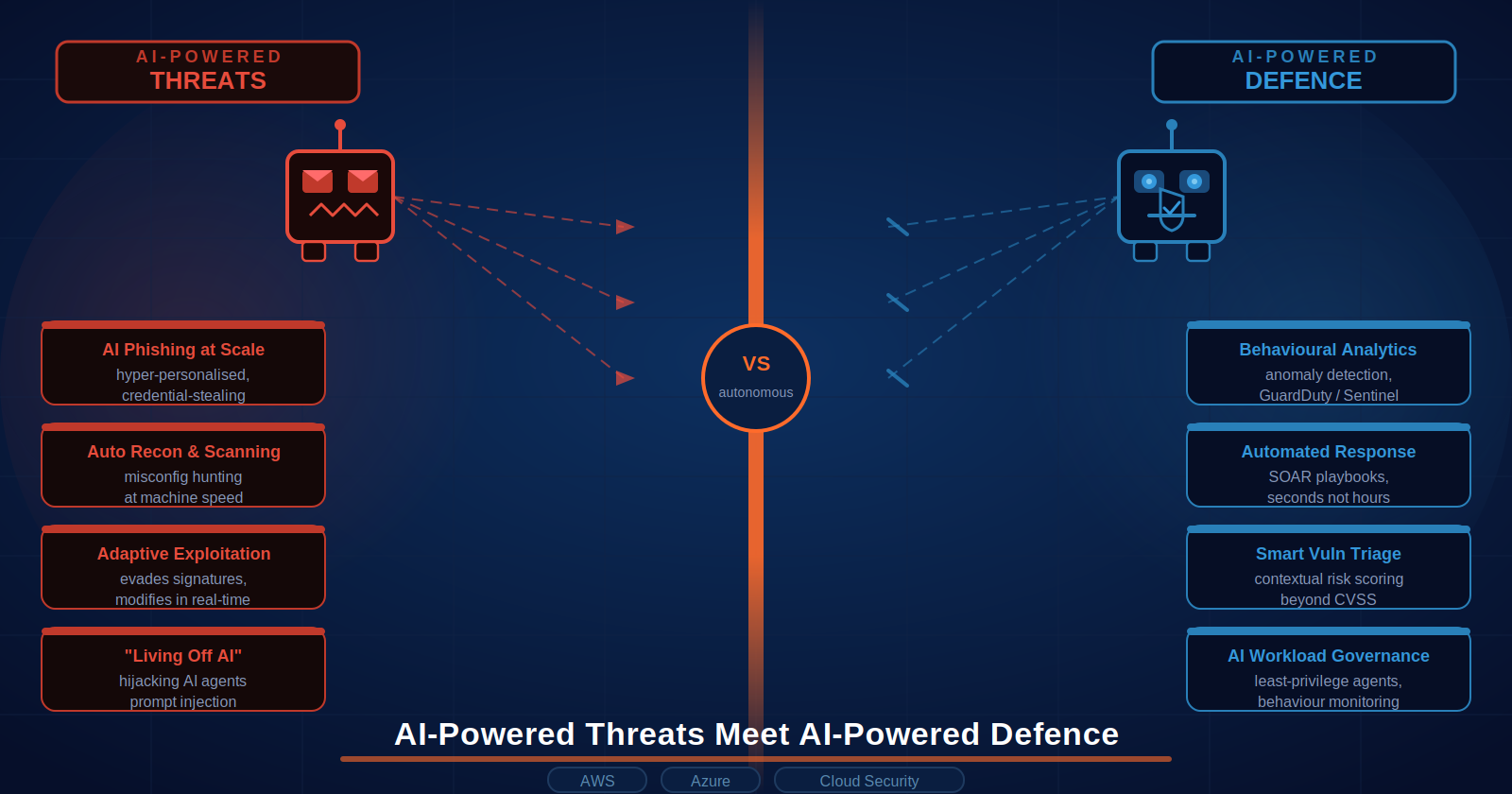
Artificial intelligence has fundamentally altered the threat landscape. Adversaries are using generative AI to craft phishing emails that are indistinguishable from legitimate communication. They’re using machine learning to scan cloud environments for misconfigurations at a pace no human team could match. They’re deploying automated tools that can identify, exploit, and laterally move through a vulnerable environment in minutes.
On the defence side, AI is powering a new generation of security tools that detect anomalies in real-time, correlate signals across vast datasets, and trigger automated responses before an analyst has even opened a dashboard. The organisations that will be most resilient are those that understand both sides of this equation and build their cloud security posture accordingly.
At Mobilise, we sit at the intersection of cloud architecture, DevOps, and data and AI. This unique position gives us a practical perspective on how AI is reshaping both the threats to cloud environments and the defences available to counter them.
The Threat Side: What AI-Powered Attacks Look Like
Understanding the threat is the first step to defending against it. Here’s how adversaries are leveraging AI.
Hyper-Personalised Phishing at Scale
Phishing remains the most common initial access vector for cloud breaches. What’s changed is the quality. Generative AI enables attackers to create phishing emails that reference real projects, mimic the writing style of specific colleagues, and include contextually relevant details scraped from public sources like LinkedIn, company blogs, and press releases.
These aren’t the grammatically awkward, generic phishing attempts of five years ago. They’re targeted, convincing, and scalable. An attacker can generate thousands of personalised phishing emails in minutes, each tailored to a different recipient within the same organisation.
For cloud environments, the target is often credentials, particularly those that provide access to AWS consoles, Azure portals, or CI/CD pipelines. A single compromised set of credentials, in an environment without MFA or conditional access, can provide an attacker with a foothold that takes months to detect.
Automated Reconnaissance and Misconfiguration Hunting
AI-powered scanning tools can enumerate cloud environments at extraordinary speed, identifying exposed storage buckets, overly permissive security groups, publicly accessible databases, and misconfigured identity policies. What might take a human attacker days to map manually, an AI-assisted tool can accomplish in minutes.
These tools are particularly effective against large, complex multi-cloud environments where configuration consistency is difficult to maintain. A single misconfigured resource in a development account can provide the entry point for an attack that escalates into production.
Adaptive Exploitation
Traditional exploits follow a predictable pattern: identify vulnerability, deploy known exploit, attempt access. AI-assisted exploitation is more adaptive. Machine learning models can analyse the specific configuration of a target environment and adjust their approach in real-time trying different techniques, evading detection signatures, and modifying payloads based on the defences they encounter.
This adaptability makes traditional signature-based detection increasingly unreliable. If an attack doesn’t match a known pattern, rule-based security tools will miss it.
“Living Off AI”
A newer tactic emerging in 2026 involves attackers exploiting AI systems that are already present within a target environment. If an organisation has deployed AI agents, chatbots, or automated workflows with access to sensitive data or cloud APIs, an attacker who can manipulate these systems through prompt injection, data poisoning, or credential theft can leverage the organisation’s own AI infrastructure against it.
This is particularly concerning for organisations that have rapidly adopted agentic AI without fully considering the security implications. An AI agent with broad permissions becomes an attractive target: it’s already authenticated, it’s already trusted, and it can perform actions at scale system wide.
The Defence Side: How AI Strengthens Cloud Security
The same AI capabilities that empower attackers also provide defenders with powerful new tools. Here’s how organisations can use, and are using, AI to strengthen their cloud security posture.
Behavioural Analytics and Anomaly Detection
AI-powered security tools excel at establishing baselines of normal behaviour and identifying deviations. Rather than relying on signatures of known attacks, these tools learn what “normal” looks like for your environment —which users access which resources, at what times, from which locations, using which patterns and alert when activity falls outside those norms.
On AWS, Amazon GuardDuty uses machine learning to analyse CloudTrail, VPC Flow Logs, and DNS logs for indicators of compromise. On Azure, Microsoft Sentinel combines AI-driven analytics with a vast threat intelligence dataset to identify suspicious activity across your entire estate.
The advantage of behavioural analytics is that it can detect novel threats attacks that don’t match any known signature but that represent a clear deviation from expected patterns. A service account that suddenly begins accessing resources it has never touched, a user logging in from an unusual location at an unusual time, a spike in API calls to a sensitive service these anomalies are invisible to rule-based tools but immediately apparent to AI-powered analytics.
Automated Threat Response
Detection without response is just observation. AI-powered security platforms can not only identify threats but trigger automated responses isolating compromised instances, revoking suspicious credentials, blocking malicious IP addresses, and initiating forensic data collection all within seconds of detection.
AWS Security Hub combined with EventBridge and Lambda allows organisations to build automated response playbooks that execute without human intervention. Azure Sentinel’s SOAR (Security Orchestration, Automation, and Response) capabilities provide similar functionality.
The key is designing these automations carefully. Overly aggressive automated responses can cause disruption revoking a legitimate user’s access or isolating a healthy instance. The most effective approaches use tiered responses: immediate, automated actions for high-confidence threats, and human-in-the-loop escalation for ambiguous situations.
Intelligent Vulnerability Prioritisation
Not all vulnerabilities are equal. AI-powered vulnerability management tools go beyond CVSS scores to assess the actual exploitability and business impact of each finding. They consider factors like whether a vulnerable resource is publicly exposed, whether an attacker could reach it from an initial access point, and whether exploitation would give access to sensitive data.
This contextual prioritisation is essential in cloud environments where the volume of findings from scanning tools can be overwhelming. Without intelligent prioritisation, security teams waste time on low-risk findings while genuinely dangerous vulnerabilities remain unpatched.
Predictive Security Posture Assessment
Emerging AI-driven tools can simulate attack paths through your cloud environment essentially performing automated red-team exercises to identify the most likely routes an attacker would take and the controls they would encounter, allowing the red team to focus solely on critical paths to evaluate. This predictive capability allows organisations to proactively harden their environments against the most probable attack scenarios, rather than reacting to threats after they materialise.
Practical Steps
Whether you’re an enterprise or a public sector organisation running workloads on AWS and Azure, here’s how we recommend approaching the AI security challenge.
Harden Your Human Layer
AI-powered phishing demands AI-powered defences. Deploy email security solutions with AI-driven detection that analyse content, context, and sender behaviour not just domain reputation and known signatures. Enforce MFA on all accounts, with phishing-resistant methods (FIDO2 security keys or passkeys) for high-privilege users. And invest in user awareness training that reflects the current threat, not the crude phishing attempts of the past.
Eliminate the Low-Hanging Fruit
AI-powered reconnaissance tools will find your misconfigurations faster than you can. Run automated compliance scans using AWS Security Hub, Azure Defender for Cloud, or tools like Prowler and ScoutSuite. Fix the basics first: no public S3 buckets, no open security groups, no unencrypted databases, no unused IAM credentials. These are the targets that automated tools hit first.
Deploy AI-Native Monitoring
Enable and properly configure cloud-native AI-powered security services. GuardDuty on AWS. Microsoft Defender and Sentinel on Azure. Ensure they’re receiving all relevant data sources and that alerts are routed to teams who can act on them. Invest time in tuning to suppress known false positives and ensure that genuine alerts aren’t lost in noise.
Govern Your AI Workloads
If you’re deploying AI agents, LLMs, or automated workflows, treat them as first-class security subjects. Define and enforce least-privilege access for every AI workload. Monitor their behaviour against expected patterns. Implement input validation and output filtering to mitigate prompt injection risks. And maintain the ability to immediately revoke an AI agent’s access if its behaviour becomes anomalous.
Build Automated Response Playbooks
For the highest-severity threat scenarios compromised credentials, data exfiltration attempts, ransomware indicators build automated response playbooks that can execute in seconds. Test these playbooks regularly through simulated incidents. The goal is to reduce mean time to response from hours to minutes to seconds for the threats that matter most.
Where Mobilise Helps
Mobilise’s combination of cloud architecture expertise, DevOps capability, and data and AI practice makes us well-positioned to help organisations navigate the AI security landscape. We don’t just deploy monitoring tools, we design the underlying cloud architecture to be defensible, build the pipelines that enforce security controls, and help teams develop the operational capability to sustain their security posture.
Our work with UK government departments and private sector enterprises means we understand the regulatory context, the operational constraints, and the practical realities of securing cloud environments at scale. If you’re looking to strengthen your defences against AI-powered threats or to ensure that your own AI deployments are secure we’d welcome the conversation, Contact Us today.